TMJ Referral Center for Dentists
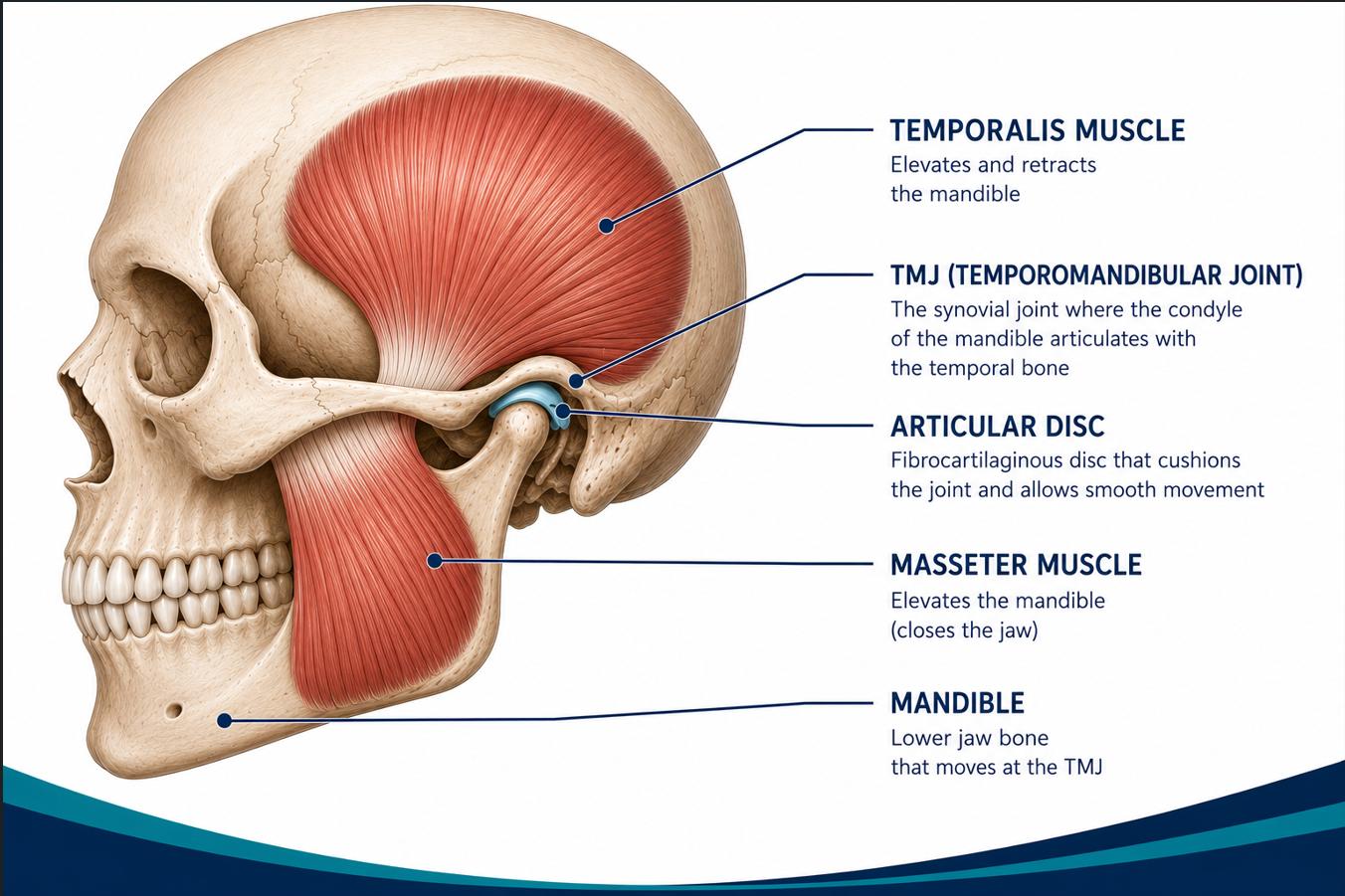
Temporomandibular Joint
Conservative Co-Management for Patients with Persistent Muscular TMD
Thank you for considering St. Luke’s Health & Wellness as a co-management partner for your patients with temporomandibular disorders.
Our goal is simple:
Help reduce muscular pain, guarding, and dysfunction so your dental treatment can proceed more comfortably and effectively.
We are not here to replace dental care. We are here to support it by addressing the neuromuscular component that often contributes to persistent jaw pain, limited opening, bruxism-related discomfort, and headaches.
Patients Who May Benefit From Referral
Patients may be appropriate for co-management when they have:
Persistent jaw muscle tenderness
Bruxism or clenching-related pain
Morning jaw soreness or fatigue
Headaches associated with jaw tension
Limited or guarded opening
Pain with chewing
Chronic neck tension accompanying TMD symptoms
Limited progress with appliance therapy alone
These are often the patients who continue to hurt even when the appliance fits well and the dental plan is appropriate.
The Missing Neuromuscular Component
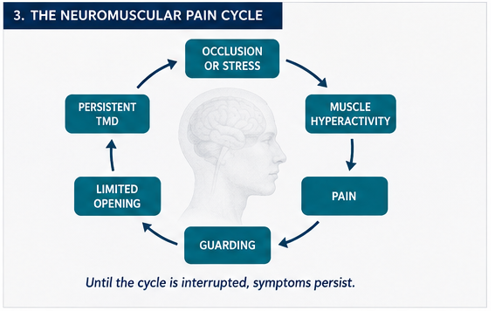
Neuromuscular Pain Cycle
TMD is often multifactorial.
Occlusion, joint mechanics, muscular hyperactivity, cervical dysfunction, stress, sleep, and nervous system sensitivity can all contribute to a patient’s symptoms.
In many persistent cases, the limiting factor is not the appliance.
It is the muscle guarding, trigger point activity, and neuromuscular pain cycle that continues after the dental component has been addressed.
Our focus is on helping calm that system.
What We Commonly Help With
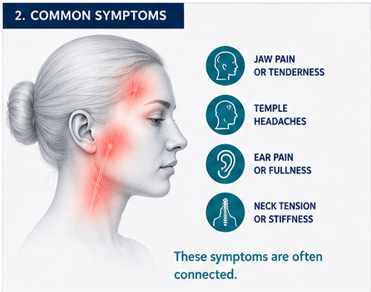
Symptoms of TMJ Disorder
We commonly co-manage patients with:
Myofascial TMD
Masseter and temporalis tenderness
Bruxism-related muscle pain
Trigger point referral pain
Limited mandibular opening
Headaches associated with jaw tension
Cervical contribution to jaw pain
Persistent muscular guarding
Treatment may include acupuncture, dry needling, myofascial therapy, cervical stabilization, neuromuscular re-education, and home care recommendations when appropriate.
The goal is not simply to treat pain.
The goal is to improve function and help the patient return to successful dental care.
What Happens After You Refer?
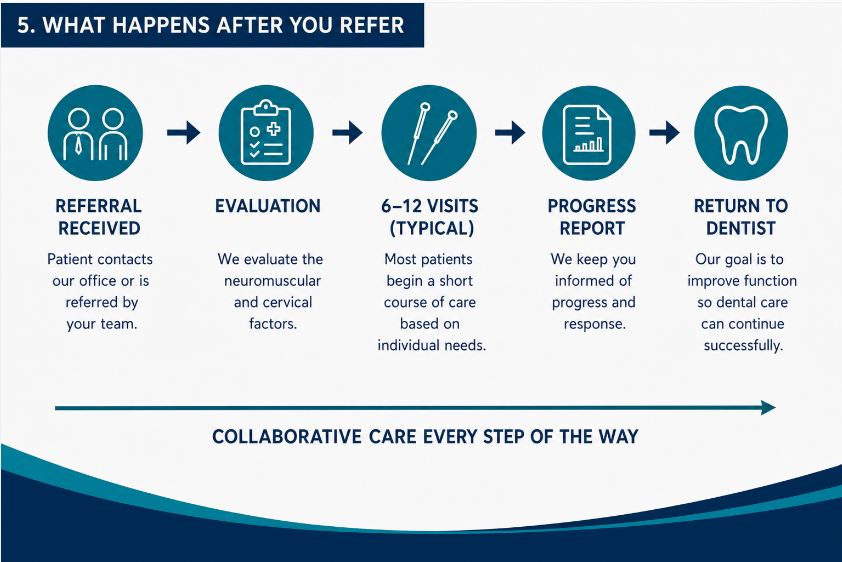
Collaborative Care Process
Our referral process is designed to be simple and collaborative.
1. Referral Received
Your patient contacts our office or is referred directly by your team.
2. Initial Evaluation
We evaluate the neuromuscular and cervical components contributing to jaw pain, muscle guarding, limited opening, and related symptoms.
3. Treatment Plan
Most appropriate patients begin with a short initial course of care, often 4–6 visits, depending on presentation and response.
4. Progress Update
We provide communication regarding clinical findings, progress, and whether continued co-management is appropriate.
5. Return to Dental Care
Our goal is to reduce muscular barriers so the patient can continue dental treatment more comfortably and successfully.
Communication With the Referring Dentist
Professional Communication Process
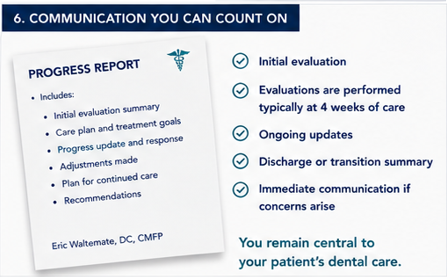
We believe communication is essential.
When appropriate, we provide:
Initial evaluation summary
Progress update
Discharge or transition summary
Immediate referral back if dental pathology is suspected
Clear distinction between neuromuscular findings and dental concerns
You remain central to the patient’s dental care.
We simply help address the muscular and neuromuscular component that may be limiting progress.
Conditions Requiring Dental or Surgical Management
We do not manage every jaw pain case.
Patients with the following concerns should remain under dental, oral surgical, medical, or emergency care as appropriate:
Odontogenic pain
Acute infection
Fracture
Acute trauma
Progressive neurological deficits
Surgical pathology
Unstable occlusion requiring dental management
Suspected serious pathology
If we identify concerns outside our role, we refer the patient back promptly.
About Eric Waltemate, DC
About Dr. Waltemate
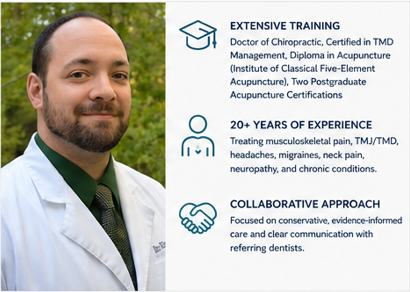
Eric Waltemate is a chiropractic physician, acupuncturist, herbalist, and nutritionist with more than two decades of clinical experience treating musculoskeletal pain and neuromuscular dysfunction.
His relevant training includes:
Doctor of Chiropractic
Certified in TMD Management
Diploma from the Institute of Classical Five-Element Acupuncture
Two postgraduate acupuncture certifications from Logan University
Advanced training in dry needling
Former postgraduate acupuncture instructor
Experience teaching continuing education acupuncture courses for chiropractic physicians
Clinical focus on TMJ/TMD, headaches, migraines, neck pain, neuropathy, and chronic musculoskeletal conditions
At St. Luke’s Health & Wellness, we emphasize conservative, collaborative care for patients whose symptoms may involve both dental and neuromuscular contributors.
Our Co-Management Philosophy
You manage the dental component.
We help address the muscular and neuromuscular component.
Together, we can often help patients who otherwise remain stuck in a cycle of pain, guarding, limited opening, and frustration.
When the muscles stop fighting treatment, dentistry can work better.
Refer a Patient
If you have a patient with persistent muscular TMJ symptoms, limited opening, bruxism-related pain, or plateaued progress with appliance therapy, we would be happy to evaluate whether co-management is appropriate.
St. Luke’s Health & Wellness
Eric Waltemate, DC, CMFP
Phone: (618) 207-4445
Website: https://www.stlukeshealthandwellness.org e-mail: info@stlukeshealthandwellness.org Location: 4509 N. Illinois St. Swansea, IL 62226